
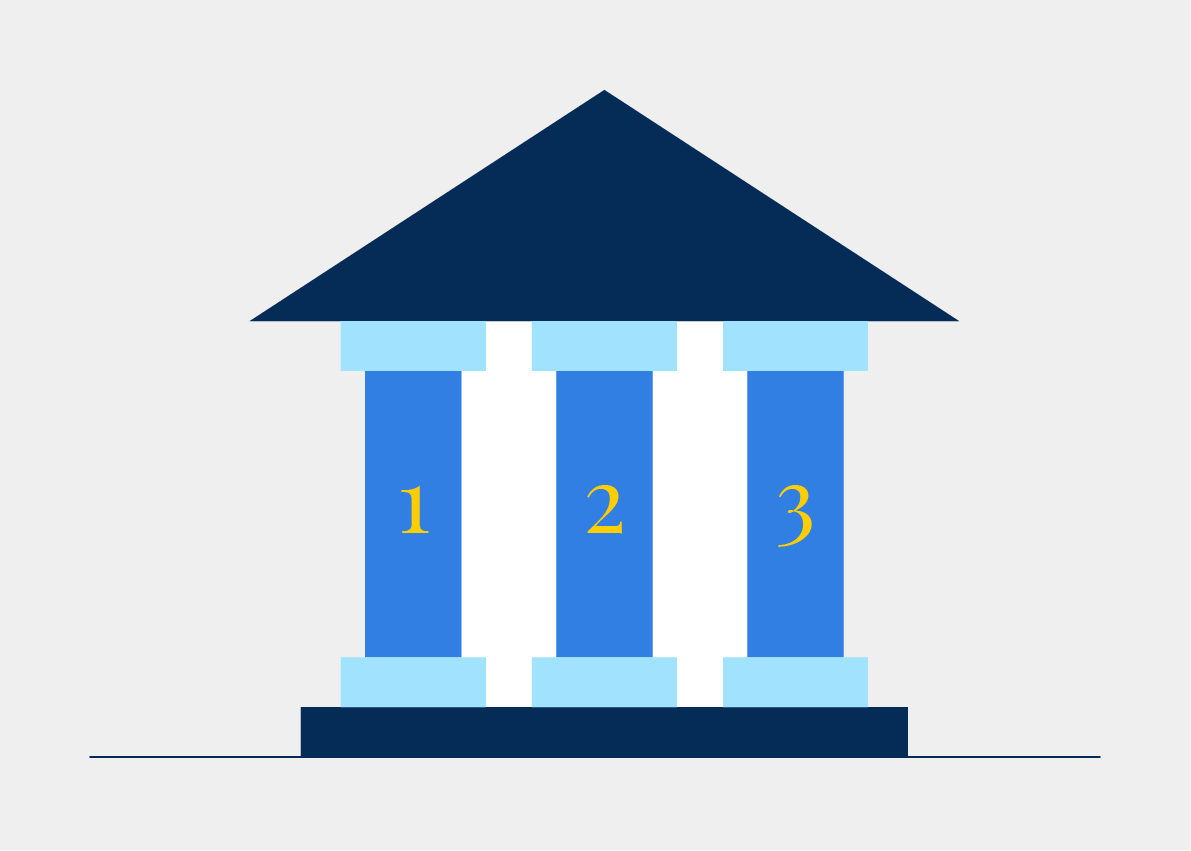
The tax advantages of Swiss pension provision
In Switzerland, the three-pillar pension system offers not only financial security in retirement, but also attractive opportunities to save tax. As 2025 approaches, it is important to know the new deduction limits and the tax advantages available both to Swiss residents and to cross-border commuters.
This article explores the differences between the second pillar (occupational pension) and the third pillar (private pension provision), focusing on the tax changes and saving opportunities for both residents and cross-border commuters.
Tax advantages of the second pillar (occupational pension)
The second pillar is compulsory for employees whose income exceeds a certain threshold. From 1 January 2025, the new entry threshold will be CHF 22’680 a year (3/4 of the new maximum annual Old-Age and Survivors’ Insurance (AHV/AVS) pension of CHF 30’240).
The importance of voluntary contributions to the second pillar (pension fund):
- Closing pension gaps: to cover any periods without contributions due to a late start to one’s career, stays abroad or other interruptions in contributions.
- Optimising tax planning: reducing the tax burden through contributions to the pension fund.
- Increasing retirement capital: taking advantage of compound interest to boost the value of the accumulated assets.
- Retiring early: improving benefits for early retirement, whether as a pension or as a lump sum.
- Making use of the extra-mandatory plan: making purchases beyond the legal minimum to increase one’s cover.
- Offsetting gaps resulting from early withdrawals: such as those for buying a home or starting a company, or to offset assets split in the event of divorce
Simulation of a voluntary contribution to the pension fund:
Insured person’s details:
- Place of residence: Bellinzona
- Age at start of stable employment: 35
- Pension gap period: 10 years (from age 25 to 35), during which no contributions were made to the second pillar.
- Net taxable income: CHF 70’000
As this person has a 10-year contribution gap, a voluntary purchase of up to 10 years of contributions is permitted to close this gap, in line with the pension plan regulations.
Statutory contributions and voluntary payments to recognised pension institutions are governed by the following laws and ordinances:
- Federal Act on Direct Federal Taxation (Art. 33 para. 1 let. d DBG/LIFD)
- Federal Act on the Harmonisation of Direct Taxes of the Cantons and Communes (Art. 9 StHG/LAID)
- Ordinance on Tax Deductions for Contributions to Recognised Pension Schemes (Art. 1 BVV 3/OPP 3)
Simulation of the tax saving from a CHF 10’000 contribution to the pension fund:
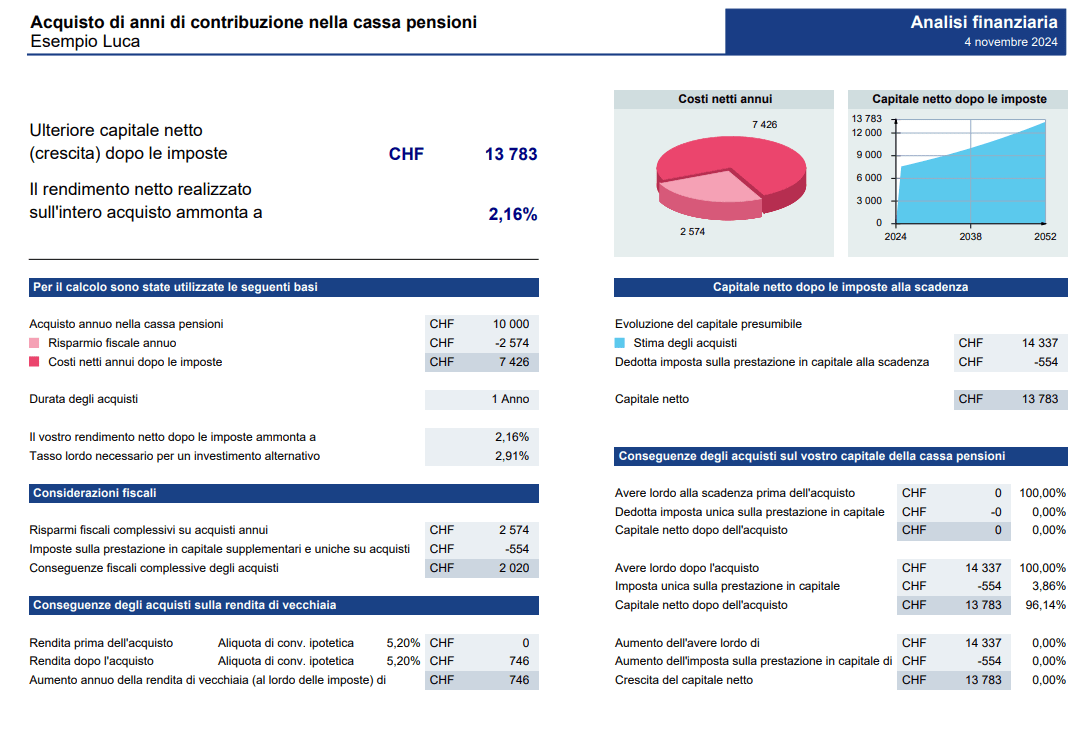
This example shows how a voluntary contribution to the pension fund not only increases retirement capital, but also offers immediate tax benefits such as:
- Tax saving: a net tax saving of CHF 2’020 thanks to the tax deduction.
- Growth in net capital: after tax, net capital reaches CHF 13’783.
- Net gain: with a net return of 2.16% after tax, the contribution effectively increases retirement assets.
Restrictions on purchases into a pension fund:
- Maximum purchase amount: this is shown on the latest BVG/LPP certificate.
- Repayment of vested benefits: if vested benefits have been withdrawn in the past, they must be repaid before you can benefit from the tax advantages of the purchase.
- Early withdrawal for home ownership: if capital has been withdrawn in the past to buy a home, the amount must be repaid in full before making new voluntary purchases.
- Three-year lock-in period: voluntary contributions to the pension fund are subject to a three-year lock-in period, during which they cannot be withdrawn as a lump sum; only withdrawal as a pension is possible.
Useful tips:
- Check your pension fund certificate: before purchasing contribution years, it is advisable to check your latest pension fund certificate to determine the maximum purchase amount and your current pension situation.
- Seek expert advice: consult a pension expert to assess whether the purchase is feasible given your financial situation and retirement goals.
- Business owners: if you own a company, we recommend not making the contribution from a business account, but from a private account.
- Capital projections: ask your pension fund for projections of your future capital so that you can plan your retirement as well as possible, optimising contributions and assessing pension and lump-sum scenarios.
- Compound interest return: a larger capital ensures a better return over the long term, thanks to compound interest. Currently, the guaranteed rate is at least 1.25% on the mandatory part, while on the extra-mandatory part the return may vary around 0.5%, but is not guaranteed.
Tax savings in tied pillar 3a (private pension provision)
Maximum permitted deductions 2025 :
- Employees (affiliated to a pension fund): CHF 7’258/year
- Self-employed persons (not affiliated to a pension fund): CHF 36’288 or a maximum of 20% of income
Generally, compared with the second pillar, the third pillar is individual and voluntary; its advantage is that people with modest incomes can pay in a small monthly amount starting from CHF 100 a month (CHF 1’200 a year) up to a maximum of around CHF 604 a month (CHF 7’258 a year).
Premium and personalisation: The amount paid into the third pillar is determined according to personal needs and the share of income available for saving. This flexibility makes it possible to adapt pension contributions to one’s own needs, contributing to future financial security without committing excessive resources.
The tax advantages are as follows
- Full deductibility (100% of contributions from taxable income)
- Exemption from wealth and income tax (during the savings period)
- Reduced tax on withdrawal, as with the 2nd pillar (favourable rate)
Calculation example:
Luca, with a net taxable income of CHF 70’000 and taxable wealth of CHF 50’000, pays CHF 7’000 into his pillar 3a.
- New taxable income: CHF 63’000 (after the contribution).
- Tax saving: CHF 1’802 for the year.
Simulation with a tax comparison of incomes:
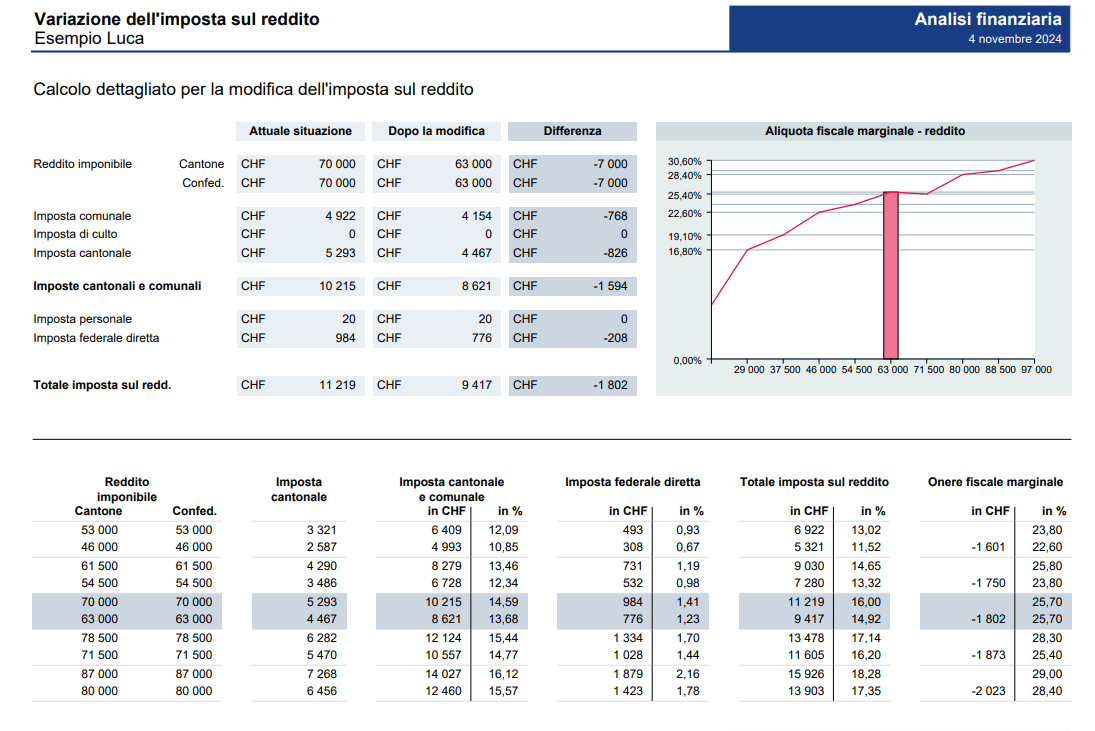
As the chart shows, the reduction in taxable income leads to a lower tax rate, resulting in a tax saving for a single year of CHF 1’802.
Useful tips:
- Pension analysis: before taking out a third-pillar policy, it is essential to carry out a thorough analysis of your pension needs and careful retirement planning, including all the necessary documentation.
- Always state your personal goals: buying a home, moving abroad, retiring early, getting married or wishing to start your own business.
- Consider the financial needs required to cover individual and family risks, such as:
- Short / medium / long-term incapacity to work due to illness or accident
- Death due to illness or accident
- Old age, both as a couple and individually (different provisions between the first and second pillars if a spouse dies after retirement)
- Unemployment / loss of income
- Annual financial budget: draw up an annual financial budget (fixed and variable costs) and determine a free share to be allocated to savings and to covering the risks mentioned above
- Don’t put it off: tackling planning straight away is crucial, because once a risk situation has occurred, it will rarely be possible to remedy it.
- Rely on expert advisers: The complexity of pension matters requires the support of experienced specialists who can offer solutions tailored to your needs and appropriate assistance.
Tax advantages for cross-border commuters: recovering withholding tax
Cross-border commuters who work in Switzerland and live in neighbouring countries can benefit from further tax advantages linked to the second and third pillars. Part of the withholding tax paid in Switzerland can be recovered thanks to third-pillar contributions and, in some cases, second-pillar contributions, by declaring them in the country of residence.
Procedure for recovering withholding tax:
- Submission deadline: the request must be sent by 31 March of the following year.
- Request for correction: for voluntary contributions to the second and third pillars, you can request a correction of withholding tax by completing Form 2, available on the Canton Ticino website at the following link: Request for correction of withholding tax – DC (DFE) – Republic and Canton of Ticino
Conclusion
The second and third pillars not only ensure a more solid pension, but also offer excellent tax-saving opportunities, enhanced by the new 2025 limits. For residents and cross-border commuters alike, pension planning is an effective strategy for optimising the tax burden. Investing in the third pillar and taking advantage of the benefits offered by the second pillar is a decision that allows you to look to the future with greater peace of mind, ensuring tax savings today and financial sustainability tomorrow.
Article written by

Stefano Radaelli
Insurance and pension adviser
Social insurance specialist with federal diploma